
Article: The Gentleman's Cut
The Gentleman's Cut
Fiction, mostly
For most of my life, I did not have a barber. I had a barbershop, which is different. Kepler’s, on the square, four chairs, and I took whoever came open first, the way you take a parking spot. Dale gave you a flattop whether you asked for one or not. Ronnie talked the whole time about a boat he was going to buy and left you looking like a substitute teacher. There was a third man whose name I never learned who cut hair like he was mad at it. It didn’t matter. I kept it short. Hair, as far as I was concerned, was a maintenance issue, like gutters.
Then I met Erica.
Erica had opinions about my hair the way some people have opinions about the Middle East — long-held, deeply researched, and waiting for an opening. Three months in, she ran her fingers through it after one of Dale’s flattops and made a sound like she’d found a water stain on the ceiling.
“Who does this to you?” she said.
“Whoever’s open.”
“Whoever’s open.” She said it the way you’d repeat a diagnosis. “You let whoever’s open cut your hair.”
“It grows back.”
“That’s your whole philosophy? It grows back?”
I want to be clear that up to this point in my life, I considered this a reasonable philosophy. It had served me well through two decades of haircuts, several jobs, and at least one wedding where I was a groomsman. But Erica wanted me to grow it out — “You have good hair, and you’re wasting it,” she said, like I was letting farmland go fallow — and growing it out meant consistency, and consistency meant Renee.
Renee worked at a salon called Muse, which had a candle burning at the front desk and a small water feature and no televisions playing anything. My first appointment, I sat in the waiting area between two women getting foils and felt the way I imagine a raccoon feels indoors. Then a girl I’d never met washed my hair.
I need to describe this carefully, because it changed me. She tipped my head back into the bowl, and the water was exactly warm, and she worked the shampoo in with her fingertips, slow, at the temples, behind the ears, and somewhere in there my entire nervous system, which had spent thirty-some years bracing for something, stopped bracing. I may have made a sound. I’m told I made a sound.
Then Renee cut my hair with scissors. Just scissors, section by section, combing and checking and stepping back to look, and forty minutes later she spun the chair around, and the man in the mirror had a haircut that looked decided on. Like someone had planned it. Like I was a man with intentions.
“Oh no,” I said.
“What?”
“I can never go back.”
Renee laughed. Erica, when I got home, put her hand in my hair and left it there a second longer than usual, and I understood that I had crossed over into a new country and burned the boat.
For two years it was Renee every five weeks. Same chair, same wash, same girl at the bowl or one just as gentle. I became a man who used the word “product.” I had a small tub of something in the medicine cabinet that cost more than my first car stereo. Dale and Ronnie carried on without me at Kepler’s, cutting whoever’s hair came open, and I thought of them the way you think of a rough neighborhood you grew up in. Fondly. From a distance.
Then Renee’s appendix went.
It went on a Tuesday, and my appointment was Thursday, and I was six weeks out instead of five because of a work trip, which meant I was already past the point where my hair stopped being a haircut and became a situation. There was a thing happening over my ears. Erica had a work event Saturday — her boss, her boss’s boss, name tags — and she looked at the thing happening over my ears and said, “You have to figure something out.”
“Renee is in the hospital.”
“I know. I sent flowers. Figure something out.”
This is where the flyer comes in.
The flyer had been on the community board at the coffee place for a month, and I had read it maybe forty times while waiting for lattes. THE GENTLEMAN’S CUT, it said, in a font like a whiskey label. A new shop across town. And underneath, a list I had practically memorized: Hot lather. Hot towel. Straight razor finish. Complimentary bourbon or draft beer. Billiards. Every game on. There was a drawing of a mustached man in a barber chair looking satisfied in a way no living man has ever looked.
You have to understand what this flyer was promising me. It was promising the barbershop of yesteryear — not Kepler’s, which was the barbershop of actual yesteryear and smelled like Barbicide and Ronnie’s boat dreams — but the idea of yesteryear. The one from the ads. Leather and wood and a man calling you “sir” while another man racked the balls. I was a salon convert, sure, but somewhere in me lived a guy who wanted a hot towel and a beer and SportsCenter, and that guy had been reading this flyer for a month.
Renee was down. The flyer was up. I called and they said walk-ins welcome.
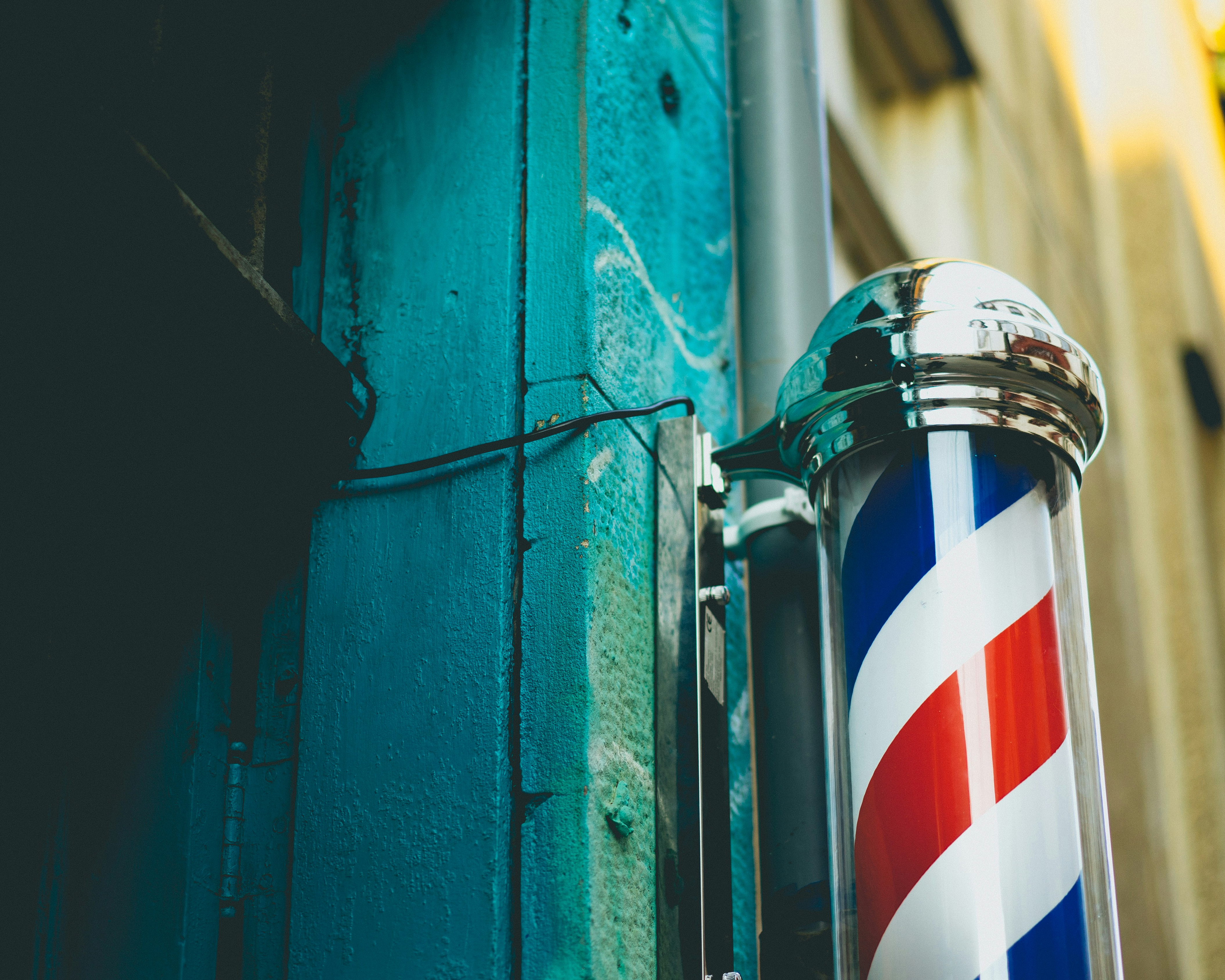
The shop was in a strip center between a tax place and a nail salon, and I want it noted that the flyer delivered on every single promise. When I walked in there was a pool table, four TVs all on sports, a cooler case with beer, heavy chrome-and-leather chairs, and the place was warm and loud with music and talk. It was, without question, the best-appointed barbershop I had ever set foot in.
It was also, entirely, a Black barbershop.
Three barbers. One customer in a chair, mid-cut, cape on. And when the door chimed behind me, all of it stopped. The talk stopped. The clippers stopped. I believe, though I cannot prove it, that the television paused. Four men looked at me with an expression I can only describe as scientific. Not hostile. Interested. The way you’d look at a deer that walked into a Walgreens.
And here is the moment. Here is the whole story, really, compressed into about a second and a half. Because I knew — the way you know things in your body before your brain files the paperwork — that there was a version of this where I patted my pockets like I’d forgotten my wallet and backed out the door. And I knew that if I did that, everyone in the room would know exactly what it was, and I would know it too, and I would carry it around forever, one more stone in the pocket. My entire knowledge of Black barbershops at this point in my life came from two Eddie Murphy movies and an Ice Cube franchise. That was the whole archive. And some deep committee in my head convened an emergency session and ruled, unanimously, that the only thing worse than staying was leaving.
“Can I get a haircut?” I said.
There was a beat. Somebody’s clippers started back up.
“Yeah, man,” said the barber nearest the door. Big guy, immaculate line-up, apron like a gunslinger. “Have a seat.”
I want you to know I played it cool. I have never played anything so cool in my life. I accepted a beer I did not want. I made a remark about the game on TV — I did not know who was playing — and the remark was received the way you’d receive a weather report from a parrot. I sat down in the beautiful old chair and he caped me and I gave him the same instruction I had given every barber in my life before Renee, six words I had said a hundred times without incident:
“Just a clean-up. Nothing drastic.”
He nodded. Professional. Reached for his clippers.
Now — Renee used scissors. Renee used scissors the way a jeweler uses a loupe. In two years I don’t think a motorized blade had come within a foot of my head. So when he snapped the guard on and the clippers came alive with the sound of a hornet dying in a coffee can, some part of me went on alert, but I told that part to sit down, because I was cool, I was so cool, I was the coolest man who had ever wandered wildly out of his depth in a strip mall.
The first pass started at the base of my neck and went straight up the back of my skull.
I have thought a long time about how to describe the sensation and the closest I can get is this: it felt like conscription. It felt like the opening twenty minutes of Full Metal Jacket. Somewhere a drill instructor was screaming and my sideburns were falling like soldiers. My head jerked away from the clippers — I didn’t decide this, my spine decided it, the same spine that once stopped bracing in Renee’s shampoo bowl now hurling itself toward the exit without the rest of me.
The clippers stopped. The shop stopped, for the second time in ten minutes, on my account.
He stepped back and looked at me in the mirror. Aghast doesn’t cover it. Insulted is closer.
“You want a haircut or not?”
“Yeah — yes. I do. It just —” I searched for the words that would fix this and found, as usual, the words that would not. “It felt like you were shaving my damned head.”
A beat. Then, from across the shop, the other customer — still caped, half his fade finished — started laughing. Not at the situation. At me, specifically, and then the barbers joined, and then it became a conversation, fast and looping and completely opaque, jokes with runways I couldn’t see and landings I couldn’t follow. I caught maybe every fifth word. At one point my barber said something that ended in “—like it’s his first day with a neck” and the whole room went up again, and I sat there under the cape, holding my untouched beer, smiling the smile of a man at a dinner party where everyone has switched to French.
He finished the cut. I’ll say this: the man was not unskilled. The man was, I suspect, extremely skilled at a specific and demanding craft that had never once, in his entire career, been asked to consider hair like mine. Fine, straight, Scandinavian-adjacent hair that lies down and sulks. What he gave me was, technically, a haircut. It had a shape. The shape was wrong on every side, and the back — Erica would later examine the back with the flashlight on her phone, silently, for a long time — the back looked like weather.
He whipped the chair around. I looked at the mirror. The mirror looked back.
“There you go,” he said, and there was something in his voice, a flicker, and I have come to believe that flicker was the exact moment he saw it too — that he knew, I knew, the whole shop knew, and we were all now bound together in a conspiracy of never saying it out loud.
“Looks great,” I said.
I paid. I tipped twenty percent. I want to dwell on the tip, because the tip is the most honest thing in this whole story. The tip was not for the haircut. The tip was a settlement. The tip said: I came into your establishment carrying two Eddie Murphy movies and a lump in my throat, I flinched like a cat, I became the evening’s entertainment, and I am prepared to pay damages. He took it with a nod. Somebody said “take it easy, man” as I left and it sounded, honest to God, almost warm.
I sat in my car in the strip mall parking lot for a while. Then I took a photo of the back of my head — this required gymnastics — and sent it to Erica, who sent it to Renee, who was one day post-appendectomy.
Renee called me directly. She never called me directly.
“Do not touch it,” she said. Her voice was thin and furious. “Do not let anyone touch it. I’ll meet you at the salon tomorrow at ten.”
“Renee, you had surgery.”
“Tomorrow. At ten.”
She showed up in sweatpants, moving carefully, one hand pressed over her incision like she was pledging allegiance to it, and she stood behind the chair and studied my head the way surgeons study X-rays, and what she said finally, quietly, with real professional grief, was:
“Oh, honey. What did they do.”
It took her forty minutes and most of her remaining strength to make me presentable, and Erica’s work event went fine, and my hair grew back, because it always does — my one philosophy, still undefeated.
Erica tells the story now at dinner parties. She’s told it so many times it has grooves in it, and every time she gets one detail wrong: she says I cried a little in the chair. I did not cry in the chair. But I’ve stopped correcting her, because the version where I cry is funnier, and because I’ve come to understand that a story, once you give it to somebody who loves you, isn’t really yours anymore. Like your hair. You can let whoever’s open take a whack at it, or you can hand it over to the one person who has decided, against all evidence, that you’re worth the trouble.
I go every five weeks. I’ve never strayed again.

Leave a comment
This site is protected by hCaptcha and the hCaptcha Privacy Policy and Terms of Service apply.