
Article: The Borrowed Heart
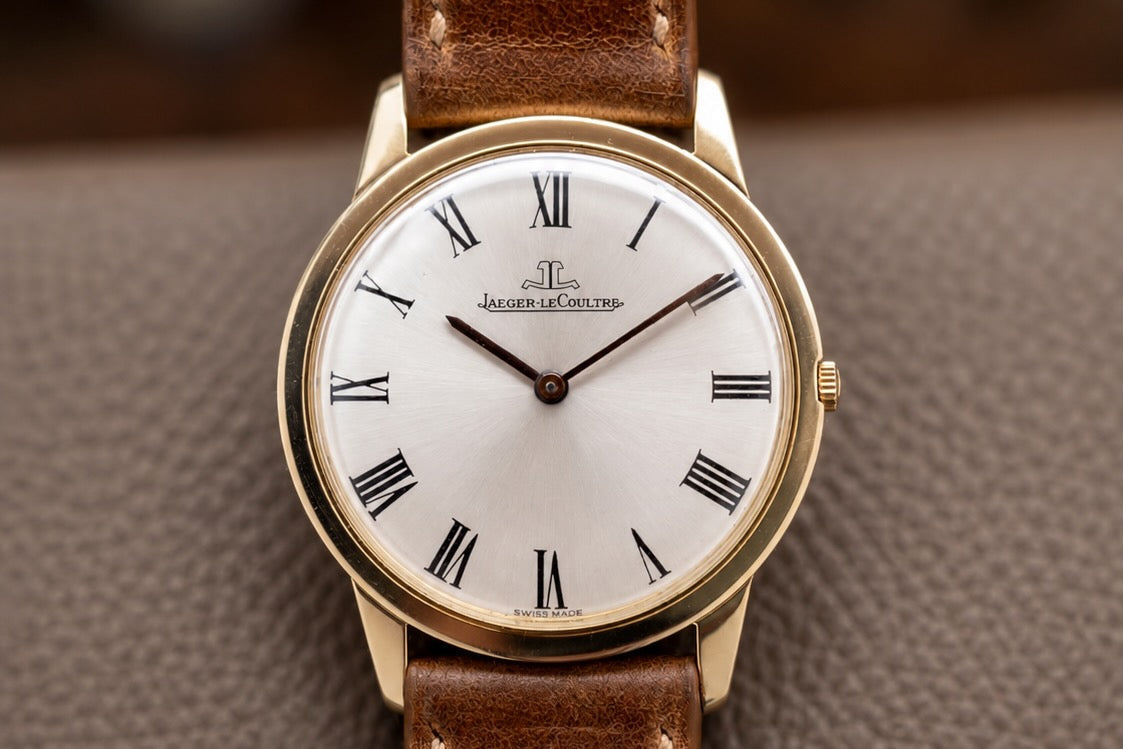
The Borrowed Heart
Why Jaeger-LeCoultre belongs in the Holy Trinity — and Audemars Piguet, on the evidence, does not
The Holy Trinity is Patek Philippe, Audemars Piguet, Vacheron Constantin, and you're meant to recite it the way you recite a creed — three names, no substitutions, no questions. So I'll ask one. What is Audemars Piguet doing in there?
Give AP its due first, because the case against it means nothing unless you're honest about the case for it. In 1972 the company did something genuinely brave. The industry could feel quartz closing in — the threat that would gut Swiss watchmaking within the decade — and AP bet the house on a steel sports watch with an octagonal bezel and eight exposed screws that cost more than a gold dress watch, which every sane person said was lunacy. Gérald Genta drew it, by his own account, in a single night. It was called the Royal Oak, it didn't merely rescue Audemars Piguet, it invented a genre, and it deserves every inch of its legend.
And then?
And then half a century of the same rectangle inside the same octagon — re-colored, re-sized, blacked out, gem-set, rainbowed, frosted, handed to a rapper, released in a "limited edition" of however many the waitlist will absorb. One idea, 1972, monetized ever since with a genius that is completely real and is entirely a genius of marketing. Nobody on earth sells desire like AP. That is a different skill from making watches, and we have quietly agreed to stop noticing the difference.
Let me own my bias before I go on, because it's the whole reason I'm writing this. I am not moved by glamour. Smoke and mirrors leave me cold. Give me the ones who did the work — the ones who built the tower so everyone else could climb up and wave from the top. That is the only watchmaking I have ever cared about, at any price, and it is the spine of everything on this site. Which is exactly why what comes next has always stuck in my throat.
Here is the part they leave out at the boutique — the part that flips the whole hierarchy on its back. The Royal Oak works because it is thin; that wafer of a case is the entire proposition. And it is thin because of the movement inside it: the caliber 920, the thinnest full-rotor automatic ever built, two and a half millimeters of engineering. Audemars Piguet did not build that movement. Jaeger-LeCoultre did. The blanks came from Le Sentier — a few miles up the Vallée de Joux from Le Brassus, where AP has always sat — and, this is the good part, JLC never once fitted the thing to a watch of its own. AP could not bring it in-house until the early 2000s, after Jaeger-LeCoultre had disappeared into Richemont. For the first thirty years, the beating heart of Audemars Piguet's defining object arrived in a box from the company we're told doesn't belong in the room.
 And it isn't only AP. The Patek Nautilus? The same heart, wearing a Patek name. The Vacheron 222? The same heart. Three of the most coveted luxury sports watches ever made, the crown jewels of the whole canon, all beating to a single engine — and the name of the company that built that engine is printed on none of them. It was the one movement good enough that all three Trinity houses used it at the same time, and not one of them could manufacture it themselves.
Now, if you're paying attention, you've spotted the trap I seem to have set for myself. If leaning on the 920 sinks Audemars Piguet, doesn't it sink Patek and Vacheron right beside it? Their icons ran on the same heart. By my own logic, shouldn't all three go out the window?
No — and the reason is the whole argument. The borrowing was never the charge. The charge is what's left of you when someone takes the borrowed thing back. Take the Nautilus away from Patek Philippe and you still have the house that has owned the perpetual calendar and the minute repeater for generations, a catalog of grand complications a mile deep. Take the 222 away from Vacheron Constantin and you still have the oldest watchmaker in continuous operation on earth — older than the United States. Take the Royal Oak away from Audemars Piguet and you have — what, exactly? A quiet repeater tradition nobody brings up, and a very long waitlist.
That's the whole test. The 920 doesn't indict the houses that used it — it sorts them. It separates the ones with somewhere to stand when the borrowed thing is gone from the one without. Patek stands. Vacheron stands. Audemars Piguet is left holding nothing but the borrowed heart, its own name stamped on the outside of it.
So let's say plainly what Jaeger-LeCoultre is, because "the watchmaker's watchmaker" has been repeated into wallpaper and people forget it is an accusation aimed at everyone else. JLC built the world's thinnest pocket watch in 1907. It built the smallest mechanical movement ever made, the caliber 101, in 1929 — the one Queen Elizabeth wore to her coronation. It built the Atmos, which runs on the temperature of the air in the room and effectively never needs winding. It built the Memovox, the Geophysic, the Master Ultra Thin, the Gyrotourbillon. It supplied Patek for thirty years, Vacheron since the twenties, Audemars Piguet since the eighteen-hundreds. It did not simply make great watches. It made the Trinity's great watches, and let the Trinity take the bow.
Now the objection, because I can hear it coming. "You just convicted AP of riding one 1972 idea for fifty years. Isn't Jaeger-LeCoultre doing precisely that with the Reverso — one rectangle from 1931, flipped and re-flipped for ninety years?"
Good. That's the right question, and it's where the argument is won rather than lost, because the two cases only resemble each other from across the room. You just watched what's left of Audemars Piguet when its icon is taken away. Take the Reverso away from Jaeger-LeCoultre and you still have the company that made the thinnest, the smallest, the Atmos, and the 920 — a titan missing one wing. One house has an icon among its inventions. The other has an icon instead of them. The Reverso is a pillar. The Royal Oak is a foundation, and if you kick it out the whole building comes down.
Which leads to the clincher the objection marches you straight into: even AP's icon is JLC's. The Reverso is what Jaeger-LeCoultre is famous for. The 920 is what Jaeger-LeCoultre is. Famous is a story somebody tells about you. The 920 is a fact you can lift with a pair of tweezers, and it is sitting inside a Royal Oak as you read this.
 The Trinity was never a ranking of who invented the most or finished the best. It was a ranking of who told the story best — and no one alive tells a story like Audemars Piguet, which is exactly how it talked the world into canonizing a house whose masterpiece runs on another company's heart. So keep the Trinity at three. Just put the right three names in it: Patek, Vacheron, and the company that built the movement the other two are famous for.
Audemars Piguet can keep the Royal Oak. It was always keeping someone else's engine anyway.

1 comment
AP got to use the movement first because they owned 40% of JLC. When Richemont bought the 60% that Mannesman owned, part of the deal they made with AP for their 40% was that AP would get the tooling and the rights to the movement.
James Dowling
Leave a comment
This site is protected by hCaptcha and the hCaptcha Privacy Policy and Terms of Service apply.