
Somebody's Old Watch
Collectors have a weakness for importance.
They want moon landings, movie stars, commandos, race car drivers. They want watches that participated in history, or at least stood close enough to history to catch some of the spray.
The Seiko Lord Matic participated in nothing.
Nobody climbed Everest with one. Nobody conquered space wearing one. It belongs to the vast anonymous middle of civilization—the people who actually keep the lights on.
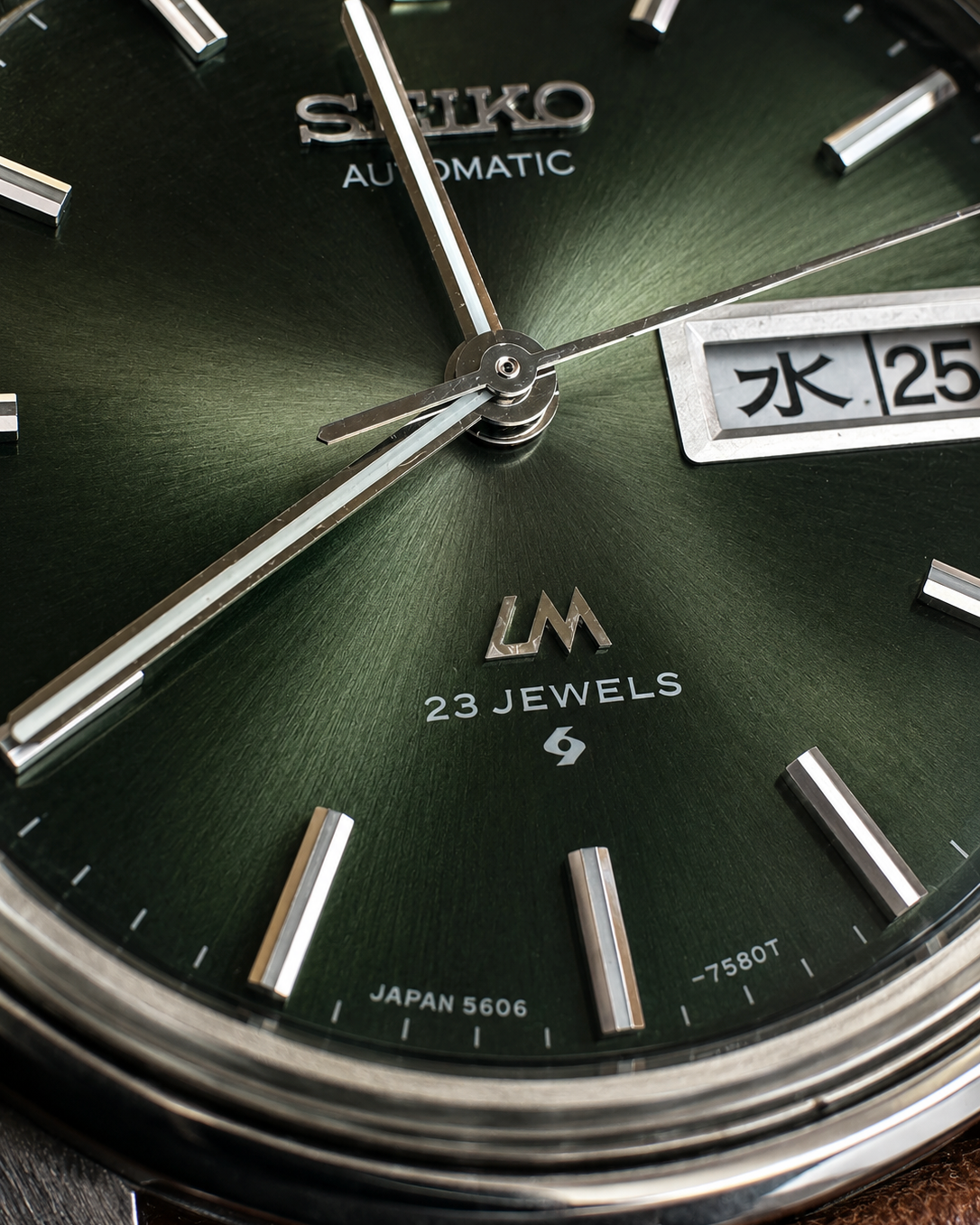
Looking at this green-dialed specimen from October 1972, I’m struck by how stubbornly uninterested it is in mythology. It doesn’t want to be admired. It doesn’t even seem to want to be noticed.
Modern luxury watches are desperate for your attention. They bulge. They glitter. They arrive wrapped in origin stories and brand manifestos. They aren’t watches so much as portable press releases.
The Lord Matic comes from an era when Seiko was busy humiliating Swiss watchmakers and was too occupied to brag about it. What the watch has instead is a kind of confidence we’ve almost completely lost.
The confidence of competence.
Today we buy watches to communicate identity. We want the watch to explain who we are before we’ve opened our mouths. In 1972, somebody bought this one because he needed a watch. That’s a different relationship entirely.
He may have even built it. Suwa Seikosha was full of people who spent the day assembling watches and went home wearing one. Whoever he was, he wasn’t curating a collection. He wasn’t building a personal brand. He wasn’t posting wrist shots. He wore the thing for years and got on with his life.
The green dial is the giveaway. Seiko has never hidden where its colors come from—the company says plainly that it pulls them out of the landscape, the snow and the forests and the green of new leaves. There was no sketch of bamboo bending toward the sun. There was a designer who looked outside and chose a color that was already true.
So this isn’t rebellion. It’s recognition. A green with no agenda—not bright enough to show off, not gray enough to disappear. One inch of himself, and then back to duty. You can imagine him standing at the counter.
Black dial.
Silver dial.
Green dial.
A moment of hesitation.
Then the green. Not the daring choice. The honest one.
And what did that honest choice buy?
Fifty-three years.
The watch stayed in Japan while entire industries rose and collapsed. It survived economic miracles, recessions, technological revolutions, and enough management philosophies to fill a library.
And then I found it, and carried it across the Pacific, and put a price on it.
Collectors love provenance because it flatters us. We want to believe we’re rescuing history. I told myself the same thing. Most of the time we’re just buying somebody else’s old stuff—and I had just bought somebody else’s old watch.
You can see the years on it, and you can see that someone minded them. The case kept its edges. The dial never faded. Whoever owned it didn’t treat it like an heirloom; he treated it like a tool he kept clean. That isn’t provenance. That’s just care, repeated until it became a record.
But every once in a while an object survives long enough to acquire a personality. This Lord Matic has one.
Not because of what it did.
Because of what it refused to do.
It refused to become obsolete. It refused to die.

Leave a comment
This site is protected by hCaptcha and the hCaptcha Privacy Policy and Terms of Service apply.