
Article: Dead Reckoning
Dead Reckoning
The 1968 Seiko Navigator Timer, ref. 6117-8000
 Everybody wants to talk about the Rolex. Fine. The GMT-Master is a beautiful object and it knows it — the way a certain kind of leading man knows it — and after a while all that self-possession curdles into a performance you've paid too much to sit through. The Seiko Navigator Timer doesn't perform. It works. That is the entire difference, and it is everything.
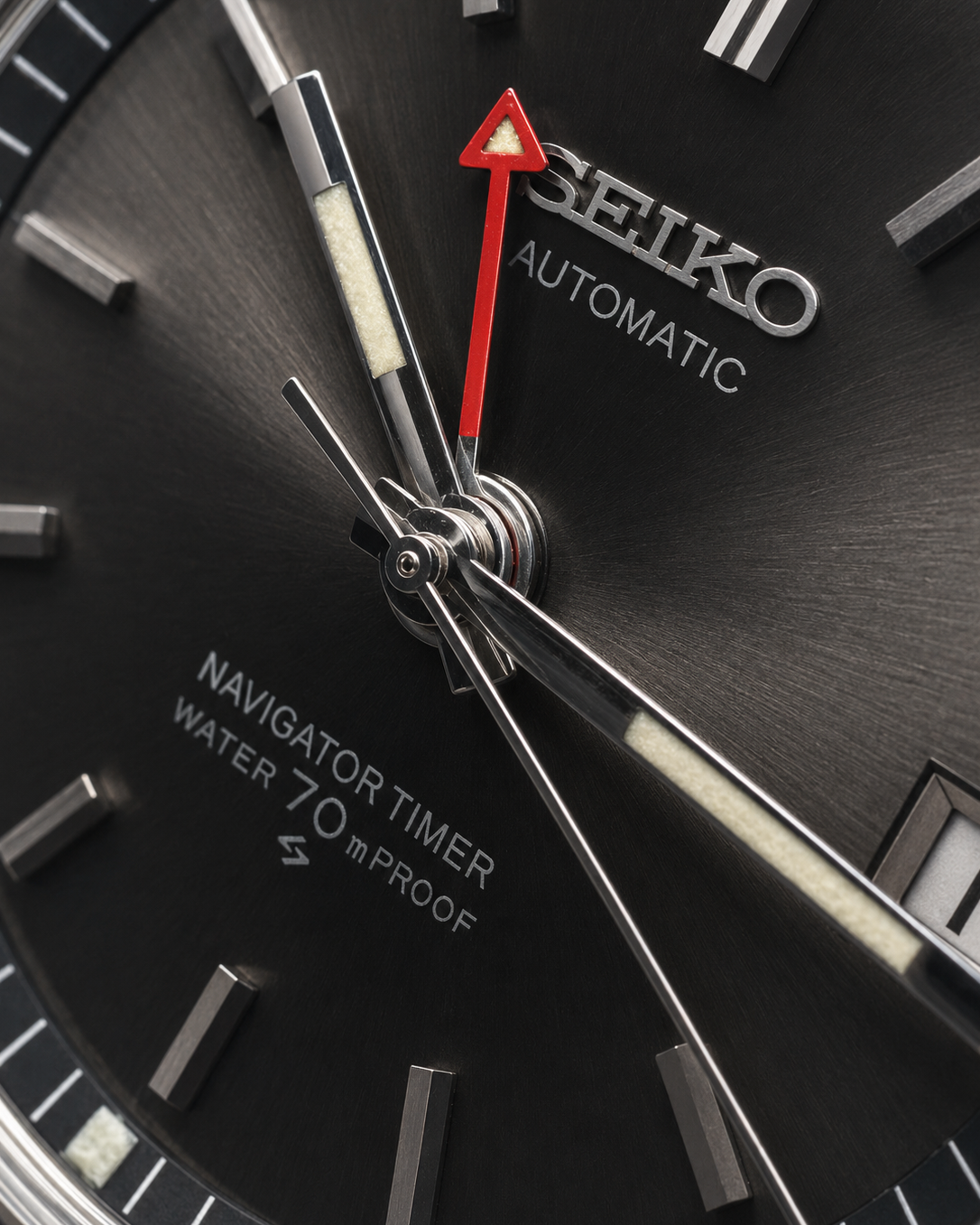
Look at the dial and try to stay bored. Seiko poured a charcoal sunburst under a coat of lacquer and let the machining do the acting: turn your wrist and the grey catches fire in a hard radial spray, dark at the rim, molten toward the center, then dark again a second later. It's a cheap trick and it's a great one — the same instinct that makes a good genre picture better than a respectable one. And straight up the middle, cutting across all that restraint, is the red arrow of the 24-hour hand, the one flare of temper on an otherwise disciplined face. You don't design that hand red because you have to. You do it because somebody in the room still had blood in him.
Here's what it's for, since the watch never brags about it. The red hand runs on a 24-hour cycle; the bezel above it turns 24 hours around. Line them up and you're reading a second time zone — home, or wherever home is this week — while the ordinary hands keep local time. It won't hack. The GMT hand is slaved to the others rather than jumping on its own, which the purists will tell you makes it the lesser mechanism. The purists are describing a spec sheet. On the wrist it means you set it once and forget it, which is what a working traveler actually wants. The story goes that these rode on the wrists of American pilots over Vietnam. The paper trail is thinner than the legend, and I won't pretend otherwise — but I won't pretend the legend doesn't move me, either. The watch wears like it believes it. So do I.
 And it is second, not first — let's be honest about the pedigree, because the honesty is more flattering than the myth. Seiko's first crack at multiple time zones was the 1964 World Timer, a busy little thing choking on a ring of city names. The 6117-8000 is what happened when they threw the clutter out and kept the idea. Same problem, solved with a clean face and a plain bezel and a case you'd actually reach for. The caliber inside, the 6117A — seventeen jewels, 21,600 beats an hour — is a workhorse, not a showpiece, and it has kept a lot of these running for closing on sixty years with nothing but a service and a shrug.
The case is where the argument lands. Thirty-eight and a half millimeters of tonneau steel, a domed acrylic crystal that warps the light at the edges like an old lens, an unsigned crown tucked down at four so it never bites the wrist. For a decade the trade called that number small; lately it's decided the number was right all along, and the whole market has wandered back to thirty-six and thirty-eight as though it had been standing there the entire time. This watch never moved. It didn't shrink to flatter the moment or bloat to survive it — it sat at the correct size and let fashion make the round trip. It doesn't announce. It fits. Restraint, it turns out, was the flex all along.
So why now, why this one. Because Seiko itself finally admitted what the collectors knew — the recent SPB411 reissue is a love letter to exactly this reference, and a company doesn't reissue the watches it's ashamed of. Because the original ladder bracelet, the flat multi-link with the signed clasp, is the piece everyone loses and nobody can find, and this example still wears its own — spare links and all, the way you only get from a house that threw nothing away. Because the case has never met a polishing wheel: the edges are still sharp, the finishes are the ones Seiko put there, and nothing has been swapped, relumed, or dressed up to flatter it. It is all here, all original, exactly as much as sixty years allow. And because the caseback serial reads to spring of 1968 — the first months off the line, the real thing, unpolished, honest.
 And here's the part no spec sheet can hold — the part that made me stop haggling. Forget the pilots; that was the myth, and I already admitted I was selling it to you. This watch carries a Vietnam story that happens to be true, and it's quieter and better for being quiet. A man bought it new in Saigon. He gave it to his son. His son gave it to his own son. Three of them carried it through everything that came for that city afterward, and not a link in the chain is guesswork — you can follow the watch from the wrist that broke it in to the hand that finally let it go. I bought it out of the same city it started in. Sixty years, three generations, one family, one place — and then it came here. Most vintage pieces are orphans by the time you meet them, their history sanded off with the case. This one came with its family still attached.
The Rolex will always cost more and say less. This one had the better idea and never charged you for the privilege. That's not the poor man's GMT. That's the one with the pulse.

Leave a comment
This site is protected by hCaptcha and the hCaptcha Privacy Policy and Terms of Service apply.