
Looking Up
The other morning, I was out walking the dogs well before dawn. I looked up and the sky was lit with stars, something I hadn’t seen in a while.
You don't miss the stars until you can't see them.
I stood there, leashes in hand, scanning the sky and recalling a warm summer night in a reclining lawn chair in my neighbor's backyard, waiting for a meteor shower the ten o'clock meteorologist had promised would start around midnight. We stayed out there for hours, staring into the dark as though the sky had made an appointment with us. Midnight came and we kept looking.
I don't remember how many meteors we saw. Maybe enough. Maybe the waiting has outlasted the event in my memory. That happens. You anticipate something for hours, and years later what remains is not the thing you were waiting for but the people beside you, the lawn chair beneath you, and the enormous darkness above.
Satellite spotting was another pastime. We would choose a section of sky and search for a point of light moving steadily across it. The rule, as we understood it, was simple: airplanes blinked; satellites did not. When someone found one, the rest of us had to follow his finger and locate it before it disappeared.
There it is. Where? Right there. I don't see it. Next to that star. Which star?
By the time everyone found it, the satellite had nearly crossed the sky. There was no app to confirm what we had seen. We could have been wrong, but it didn't matter. For a few seconds, we had detected something impossibly distant moving overhead, and that felt like discovery. We would wonder aloud if it was ours or the Russians. “Red Dawn” had us all prepared.
Satellite spotting has become considerably easier in adulthood. There are more things in orbit, and a phone can tell you what is passing, where to look, and when it will arrive. What once required patience and a certain amount of luck can now be scheduled.
Still, there was something to not knowing. You looked because something might be there.
There was a time when I could give the sky hours of attention. No destination. No result expected beyond the possibility that something extraordinary might pass overhead. Adulthood has not eliminated that part of me, but it has buried him beneath schedules, responsibilities, and the conviction that attention should produce something. Then I walk the dogs before dawn, look up, and he finds me again.
I am not an outdoorsman. I don't camp or climb mountains. I have never felt the need to demonstrate my affection for nature by sleeping in it. There is no technical clothing in my closet waiting for a sufficiently rugged weekend. I prefer a bed and soft sheets and thermostat directed comfort.
But nature is not a hobby, and our connection to it does not depend upon how much equipment we own.
The natural world has always been able to reach me. The smell of rain before it arrives. The sound of insects gathering in the dark. Grass beneath bare feet. The strange quiet after snow.
Little excites me more than the random sighting of a bald eagle in flight. It doesn’t matter what kind of person you are, for a moment, that bird releases you from whatever small thing had stolen your time. The unanswered message or the mortgage that's a week late. The meeting that should have been an email. There is a god damned bald eagle in the sky, and it's magnificent. Something ancient in us understands that this takes precedence. We call the feeling otherworldly, but perhaps that's backward. Perhaps these are the moments when we are most firmly in the world.
This is what I recognize in Grand Seiko, and in Seiko more broadly. The natural world is not somewhere beyond the company's watchmaking. It is inside the work.
Spend enough time with Grand Seiko and the landscapes begin to accumulate. Snowdrifts. Birch forests. Frozen waterfalls. Cherry blossoms caught by the wind. The surface of Lake Suwa before dawn. Mountains visible from the windows of a legendary design studio.
There are enough of them now that skepticism is reasonable. A person could conclude that Japan possesses no patch of ground, body of water, or atmospheric condition that has not been assigned a reference number. I have a bit of Hokusai's wave tattooed on my left arm, so the romance works on me too.
I understand the suspicion. Watch companies are forever asking mountains to explain their dials, but a story can be used to sell an object and still be true.
Grand Seiko's relationship with nature does not feel like an idea introduced at a marketing meeting. It appears too often and reaches too far back into the work. Nature gives the company a language for things that are difficult to express through specifications: stillness, severity, repetition, impermanence, the movement of light across a surface.
The watches do not reproduce landscapes. They preserve the experience of noticing them.
There is something about the red that blankets the sky at sunrise. I have never been able to look away from it, and I don't think anyone can encounter that color without stopping, however briefly, to make note of it.
The same is true of this watch.
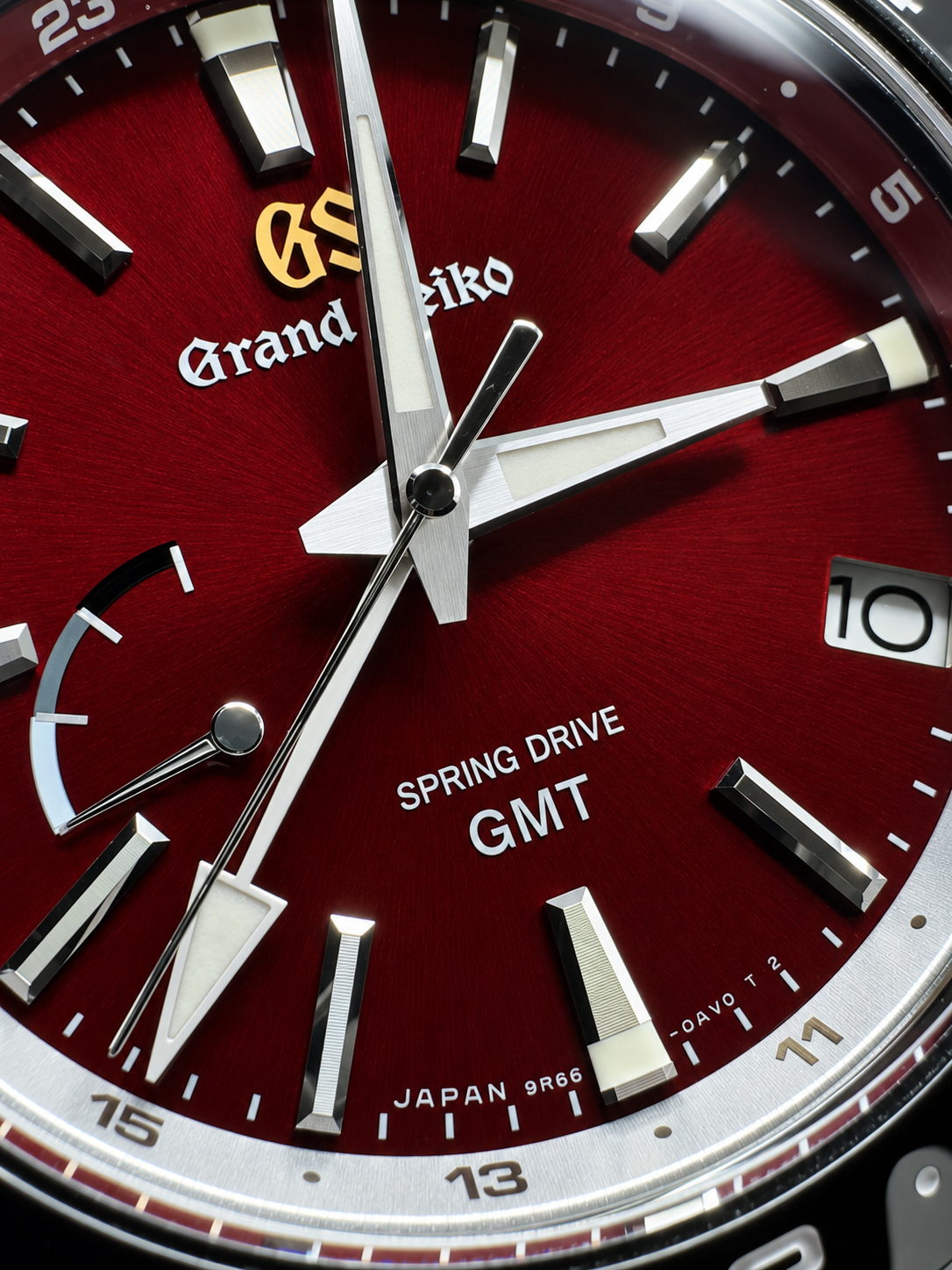
The dial of the Grand Seiko SBGE305 was inspired by the summer sunrise over the Hotaka mountain range. Those mountains rise beyond the Shinshu Watch Studio, where Grand Seiko's Spring Drive watches are made. At daybreak, red light reaches the exposed rock while the deeper faces remain in shadow.
Grand Seiko did not put a picture of a mountain on the dial. It did not engrave a tiny summit at six o'clock or shape the GMT hand like a climbing axe.
It made the dial red.
Dark red, officially, though the description does very little work. It is burgundy in one room and oxblood in another. At certain angles it appears almost black. Then the light reaches it and the color rises from underneath, as if the dial has been keeping something from you.
The effect is not peaceful. That may be what I like most about it.
Grand Seiko is often praised in the language of serenity. The praise is deserved, but it has become a little too easy. There is nothing serene about the first red light breaking over a mountain. It is beautiful, certainly, but beauty is not always gentle. Sunrise overtakes the darkness by force.
The SBGE305 has some of that violence in it too.
The black ceramic bezel keeps the watch from getting away with too much. Glossy and nearly depthless, it draws a hard boundary around the dial. Without it, the red might have slipped into costume. The bezel gives the watch discipline.
It puts night around the sunrise.
 The ceramic also serves a practical purpose. It resists the scratches that gather around the exposed edge of a watch, and its fixed 24-hour scale works with the silver GMT hand to display another time zone. The material does not merely complete the image of dark rock surrounding the morning light. It has a job.
The stainless-steel case measures 40.5mm across and 14.7mm thick. It is not delicate, and it makes no attempt to become invisible on the wrist. The broad case, dual-curved sapphire crystal, and steel bracelet give it the presence of a proper sports watch. A four o’clock crown and 200 meters of water resistance mean that it can be treated like one. On the wrist it wears every bit of that height. The diameter is moderate, but the watch stands off the arm rather than settling into it, and the bracelet carries real weight.
 This is an anniversary watch that can get wet.
That should not be remarkable, but the industry has produced a great many commemorative watches that seem frightened of life. They arrive full of history and leave the house only for dinner.
The SBGE305 was made to travel.
Its local hour hand can be adjusted independently in either direction without stopping the movement. The date follows when the adjustment crosses midnight. Home time remains where it was. You land somewhere else, correct the watch, and continue. There is no ceremony to it.
Inside is Caliber 9R66, an automatic Spring Drive GMT with approximately 72 hours of power reserve and average accuracy of ±15 seconds per month. It’s the very reason this watch exists. The SBGE305 was released in 2024 to commemorate twenty years since Grand Seiko introduced the 9R family of Spring Drive movements.
Spring Drive can sound dreary when explained badly. There is a mainspring, a quartz oscillator, an electromagnetic brake, and something called a Tri-Synchro Regulator. By the time the explanation is finished, the person listening may have lost the will to know what time it is.
The experience is simpler. The seconds hand moves without ticking.
It does not beat several times each second and create the impression of smoothness. It moves continuously. One second does not appear to end so that the next can begin. The hand simply crosses the dial, silent and uninterrupted. An eagle in flight.
People still argue about where Spring Drive belongs in the mechanical hierarchy, as though the movement has spent twenty years waiting for admission to a club. The seconds hand ignores them.
What interests me is that such an intensely engineered mechanism produces an experience that feels natural. Spring Drive required decades of technical work, yet the work disappears into motion.
Water does not tick as it travels downstream. A shadow does not jump across the lawn. The red of sunrise does not advance one beat at a time. Neither does the hand.
The meteorologist may promise a meteor shower at ten o'clock, but the sky doesn’t recognize the appointment. Nature moves according to systems we can measure without ever bringing them entirely under our authority.
Perhaps that is what the seconds hand expresses. The movement is extraordinarily precise, but its visible motion refuses to divide time into little pieces. It measures the passing moment without pretending the moment has edges.
The red dial moves beneath the light. The seconds hand moves above it. One is restless. The other is completely calm.
That is enough.
Grand Seiko made 1,300 examples of the SBGE305. Each received its own number on the caseback. This watch is number 25.
 Thirteen hundred is not a mythical quantity. It does not make the watch impossible to find or require a private appointment in Geneva. It is simply finite enough that every example has already been released into the world. They have entered collections, crossed borders, picked up scratches, disappeared into safes, and become attached to the lives of people Grand Seiko will never meet.
A limited-edition number cannot give a watch meaning. There are warehouses full of numbered objects nobody wants. But a number can put an edge around a moment.
There will be other Grand Seiko GMTs. There will be more anniversary watches and almost certainly more red dials. But this particular combination of place, color, movement, and occasion stopped at 1,300. The watch belongs to one specific point in the history of Spring Drive and to one view from the place where Spring Drive is made.
Its rarity is not the story. It keeps the story from repeating.
This example remains accompanied by its full Grand Seiko box and papers. Collectors care about such things, and so do I, though the box will spend most of its life in a closet and the papers may never be read again. Their presence tells us that someone kept the watch whole. On an individually numbered anniversary edition, that matters.
I will probably never climb the Hotaka mountains. I am comfortable admitting this. But I know the sky the watch is talking about.
It is the sky that interrupts conversation. The sky that turns windows and rooftops red for a few minutes before the ordinary blue of day takes over. The sky that once kept us stretched across lawn chairs in a neighbor's backyard because a meteorologist had told us something might happen. It is the darkness in which a moving point of light could become a satellite if we watched it long enough. It is the sky above an early-morning dog walk, full of stars I had somehow forgotten to miss.
I once believed that wonder belonged to childhood because children experience the world more intensely. I'm no longer sure that is true. Children may simply be more willing to look at something without asking what the looking is for. They will give the sky an entire evening.
The adult connection to nature is harder won. We have trained ourselves to move past things. Beauty becomes scenery. Rain becomes traffic. Grass becomes maintenance. The stars disappear behind light and weather, and eventually we stop remembering to check whether they have returned.
Then something interrupts us. An eagle. A meteor. The smell of rain. A red watch beneath the light.
Grand Seiko paid attention to a mountain outside its window. Someone noticed what happened when the morning light reached the rock and decided the experience was worth preserving. Engineers, designers, dial makers, polishers, and watchmakers carried that moment into steel, ceramic, and glass.
Now the watch causes the same interruption. You notice. You stop and look again.
The stars had been above me all along. I was the one who finally looked up.



Leave a comment
This site is protected by hCaptcha and the hCaptcha Privacy Policy and Terms of Service apply.