
Fame is a Lousy Archivist
I've never been to Paris.
Still, this watch makes me think of Paris.
I can't tell you why. The blue dial, maybe. The long rectangular case, the tan leather. Maybe Paris is one of those places you're allowed to have memories of without ever going. Movies do that. Books do that. A photograph in somebody else's drawer does that.
Whatever the reason, the first time I looked at this old Jaeger-LeCoultre, I thought Paris.
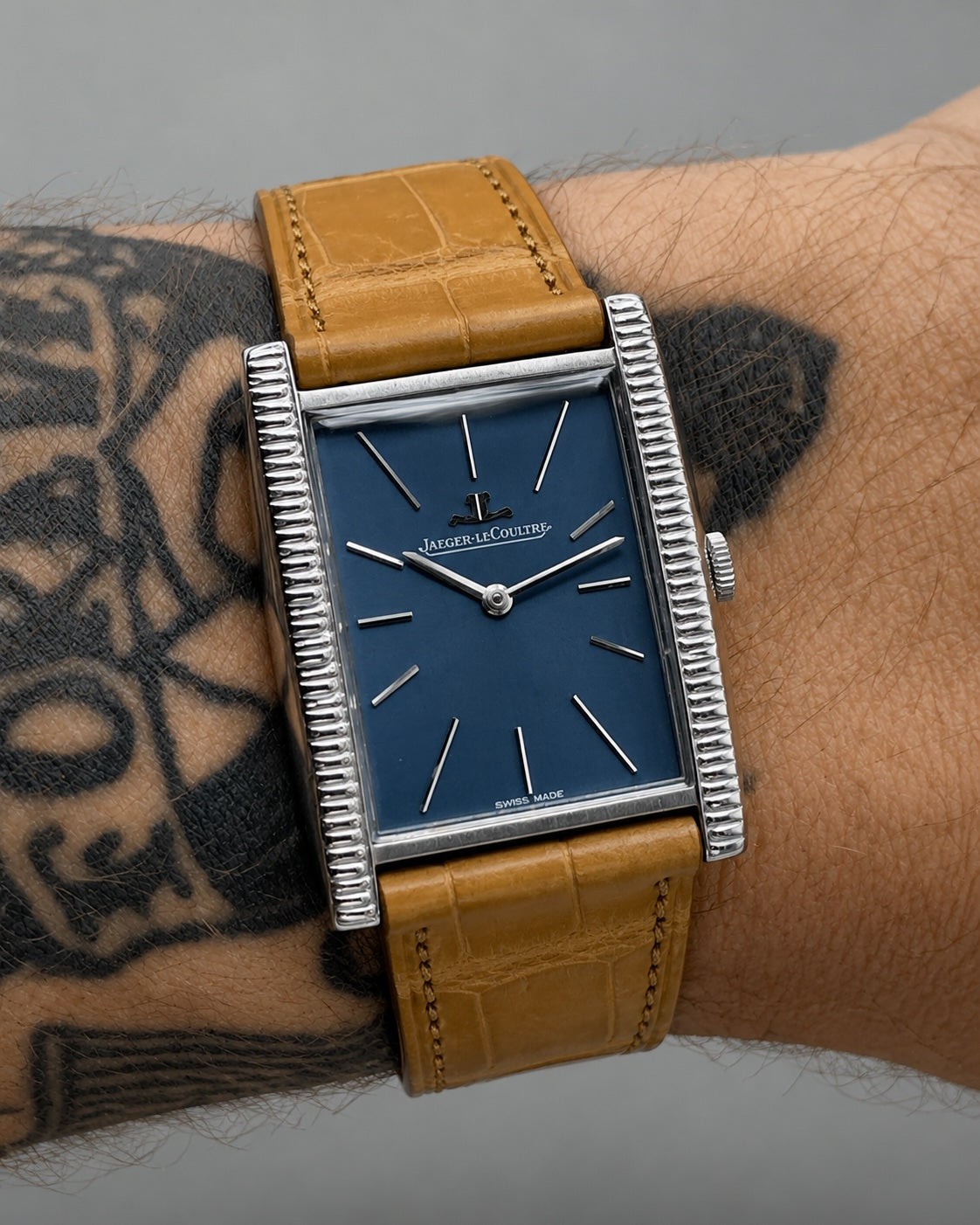
The watch is a reference 9036, made around 1973 or 1974. Rectangular, 28 by 36 millimeters. Blue dial, two hands, a manually wound caliber 818/2 inside. No date. No second hand. Nothing on the dial that doesn't need to be there. The case is .800 silver.
 And then there are the sides.
Two heavy brancards run the length of the watch. They could have been smooth, but they aren't. Somebody carved them into a repeating pattern of ridges and cuts. The silver catches light on the high spots and goes dark in the grooves. Fifty years of oxidation and wear have made the effect stronger than it started.
Whether any of this is beautiful depends entirely on who's looking.
Its importance is not so open to interpretation. The industry settled that a long time ago, and it settled it against. There are no coffee-table books devoted to the 9036. Nobody I know is arguing over Mark I and Mark II dials. There's no celebrity photograph that gets passed around the forums. Jaeger-LeCoultre itself doesn't include it among the 17 historically significant models in its Collectibles program, which covers the great watches of the manufacture from the 1920s through the 1970s. The Reverso is there. The Memovox is there. The Futurematic and the Geophysic are there. The 9036 isn't.
Fair enough.
I bought it to sell. I own a watch business. I paid less for this watch than I hope to sell it for, and there's no point pretending otherwise. Eventually, there will be photographs, a description, and a price.
But something happened between buying it and selling it. I started looking at it. Not checking it. Looking at it.
And the longer I looked, the more one thought sat on my chest.
Somebody designed this watch. Somebody sat with those two flat pieces of silver and decided they weren't finished. Somebody cared and it got forgotten anyway.
That's the part I couldn't put down. Not that the caring happened, but that the caring didn't save it.
We confuse fame with intent.
The Cartier Tank is important, so we assume every line on it deserves study. The Reverso is important, so books get written about who drew it, why, and what was happening in the rooms around the men who made it.
Then there are watches like this one. They fall out of the story.
The strange thing is that the designer didn't know that. Whoever drew the 9036 had no idea that fifty years on I'd have trouble finding a paragraph written about it. He didn't know collectors would spend fortunes on watches built down the road while his became a reference number traded on the edges of the market.
He just had a job to do, and I have a hard time believing he didn't care about it.
Look at the watch. He had choices. A rectangular dress watch is not a difficult assignment. Make a rectangle. Put a movement in it. Give it a dial. Attach a strap. He could have stopped there, but he didn't.
Somebody chose that blue. Somebody chose silver instead of gold. Somebody decided the dial needed two hands and nothing else. And somebody looked at those two long pieces of metal running down the sides and decided to cut them deep.
Why?
I don't know. His name appears to be gone, so I went looking for his world instead.
Jaeger-LeCoultre was never a Geneva company. The manufacture sat in Le Sentier, in the Vallée de Joux, where Antoine LeCoultre set up his workshop in 1833. It became one of the largest employers in the valley. The company still describes itself as a manufacture where the trades required to build its watches live under one roof.
So the man who drew this thing was almost certainly working in or near the Vallée de Joux. That's somewhere to start. It also makes my Paris thought look wrong.
Until it doesn't.
Jaeger-LeCoultre describes the meeting of Edmond Jaeger and Jacques-David LeCoultre as the joining of French style and Swiss technique. Jaeger was a Parisian watchmaker. LeCoultre was in the valley. Their relationship began in 1903 and eventually produced the company whose name is on this dial.
There was always traffic between those two worlds. Not just watches. Ideas.
And one of the more interesting ideas moving through Switzerland and France in the decades before this watch was made was the one we now call Brutalism.
I didn't know much about Brutalism when I started. I knew concrete. I knew the movie and that was about it.
Then I looked.
Le Corbusier was born Charles-Édouard Jeanneret in La Chaux-de-Fonds, Switzerland.
Watch country.
His father was a watch enameler. The boy who became one of the most influential architects of the twentieth century went to the local art school, where his gift for engraving was noticed before a teacher pushed him toward architecture. The Fondation Le Corbusier describes him growing up in an industrial town shaped by the international business of Swiss watches.
Then he went to Paris.
There is something almost too convenient about this for my argument, and I want to say plainly that I didn't invent it. One of the men most responsible for changing how twentieth-century Europe thought about buildings grew up inside Swiss watchmaking, learned to engrave, went to Paris, and helped build a language in which the material itself carried the expression.
His influence came home.
In Bern, a group called Atelier 5 was founded in 1955. Four of its five founders had worked for Hans Brechbühler, who had worked with Le Corbusier. Between 1955 and 1961 they built the Halen development outside the city, concrete first, and the architects themselves name Le Corbusier as the common model for the group.
Nobody agreed about it. People called Halen a concrete desert. Others came from around the world to study it.
In Geneva, another building was going up. Between 1968 and 1970, Urs Tschumi and Michel Heurteux built Blanvalet-Décembre. The Canton of Geneva now calls it an emblem of Genevan Brutalism and points directly at its Corbusian influence.
The façade is ribbed concrete.
That's what stopped me. Ribbed. The concrete isn't only holding the building up. Its surface is doing something. The geometry is strict and the material is rough, and light hits the raised parts differently than it hits the recesses. The texture was not applied afterward to make the thing pretty. The structure and the decoration have become hard to pull apart.
I looked at the watch again.
 Those brancards.
Now I had a theory.
I can't tell you the man who designed the 9036 was influenced by Brutalism. Nobody should tell you that without a drawing, an interview, a company memo or a man old enough to remember. I found none of those.
But criticism isn't a police report. We have the object. We have the place. We have the year. We're allowed to look at them together.
So here's my case.
I think Brutalism got into this watch.
Maybe he knew it. Maybe he didn't. He was living in a Switzerland where these ideas had stopped being theoretical. Architects with direct lines to Le Corbusier were building in raw concrete. A plainly Brutalist building had just gone up in Geneva. This stuff was around.
And the watch speaks some of the same language. Not because it's rectangular, but because of what happens to the material.
The brancards aren't engraved with flowers. They aren't polished until the silver disappears into shine. They aren't pretending to be anything except worked metal. They're silver, cut deeply enough that the surface becomes the decoration. The ridges catch light. The recesses hold the dark. The material is the ornament.
That's Brutalist to me. You can disagree. That's the deal.
Then there's the silver.
I keep coming back to it because this should be a gold watch. Not literally. Jaeger-LeCoultre could build it out of whatever it wanted. But look at the form. A thin rectangular Swiss dress watch on leather. The old vocabulary points at gold. Precious metal, polish, permanence.
This one is .800 silver, and it feels more austere for it.
 Silver has another property. It changes. Gold picks up scratches and spends its life looking more or less like gold. Steel gets chosen partly because it resists the world. Silver reacts to it. Air gets involved. Moisture gets involved. Skin gets involved. The high points get rubbed clean, the protected valleys hold their oxidation, and the whole surface darkens on a schedule nobody controls.
Now look at those carved brancards after half a century.
Time helped finish the design.
I don't know if he intended that. I'd like to think he knew the material well enough to know it would happen. I don't get to turn that into a fact because I like the idea. I can only say what's in front of me, which is this: the movement measures time and the case records it. That's true whether the metaphor was planned or not.
Then I looked at the year, and the year didn't throw me off the scent.
On April 3, 1973, Martin Cooper stood on a street in New York and made the first public call from a handheld cellular telephone prototype at his company Motorola.
On August 11, Cindy Campbell threw a back-to-school party in the rec room at 1520 Sedgwick Avenue in the Bronx. Her brother Clive played the records. We now treat that party as one of the founding moments of hip-hop.
In Paris, Tour Montparnasse opened on June 18. Fifty-nine floors, 210 meters, a dark modern rectangle dropped into one of the oldest and most famous skylines on Earth.
Paris wasn't finished changing. In 1971, President Georges Pompidou announced plans for a huge new center for modern art and culture in the heart of the city. The winning design, by the young architects Renzo Piano and Richard Rogers, looked almost nothing like the Paris around it. They put much of the building's structure, pipes and mechanical systems on the outside, where everyone could see them.
Construction began in 1972.
That was the point. Pompidou wanted France looking forward, not living forever on its old reputation for cooking, couture, champagne and cabaret. The building that would eventually carry his name was meant to make that argument in steel, glass and exposed machinery.
Then October came.
War broke out in the Middle East. Arab producers used oil as leverage. Production was cut. Embargoes followed. Prices climbed. By December, Pompidou was on television asking the French to save gasoline, electricity and heat.
The long postwar expansion they later called the Trente Glorieuses was ending. Modernity stopped looking like an escalator that only goes up.
And in Switzerland a different problem was arriving.
Quartz.
The Swiss watch industry would be gutted over the next decade. More than 1,600 Swiss watch companies were operating around 1970. By the middle of the 1980s there were fewer than 600. Employment fell from roughly 90,000 to 33,000.
Quartz wasn't the only cause. Exchange rates, labor costs, oil and industrial structure all mattered. But the old order was coming apart.
Which brings me back to this watch.
You have to wind it by hand.
The same year a man at Motorola proved a telephone could be carried down a sidewalk, Jaeger-LeCoultre put a little wheel on the side of this thing and expected its owner to turn it every morning for the rest of his life. No battery. No quartz. No rotor. Not even a second hand to prove it was running. A spring, and your thumb.
None of it was nostalgic yet. That's the part people miss. Nobody bought this watch in 1973 because hand winding reminded him of a simpler time. It was just a watch.
We made it romantic later.
Maybe that's what gets me about old things. We know what happened. They didn't.
The man who drew this watch couldn't see 2026 from his bench. He didn't know which Jaeger-LeCoultres would matter. He didn't know the Reverso would end up a pillar of the brand. He didn't know mechanical watches would nearly vanish from ordinary life and then come back as expensive objects people buy precisely because they're mechanical.
He didn't know a man in Kansas would sit with his work fifty years later and wonder what he meant by it.
That's my problem, not his. He was at work.
And I think that matters.
There are old Mustangs sitting in garages all over this country. Old Corvettes too. Most will never cross a block in Monterey. Nobody will write a catalog essay about them. Their owners will spend more restoring them than the cars will ever bring.
That doesn't mean nobody designed them. Somebody decided where the crease in the fender went. Somebody drew the instrument cluster. Somebody argued about the grille and lost. Somebody chose the shape of the door handle and went home and ate dinner and came back the next morning and did it again.
Those decisions don't stop containing thought because the market later decides another car is worth more.
Watches are no different.
Fame is a lousy archivist. It keeps the winners. Everything else becomes a reference number.
818/2.
.800 silver.
Circa 1973.
We reduce an object back down to data and then act surprised when nobody cares about it.
I'm going to sell this watch. I hope I make money on it. Maybe this essay helps me do that. I'm comfortable with the contradiction, because before it crossed my desk I didn't know the 9036 existed. Now I've spent days thinking about a man whose name I may never know.
Somehow, through fifty-plus years of wrists and drawers and moves and deaths and dealers and dumb luck, nobody melted the silver or threw the thing away. It survived.
 Here it is. The crystal is clean. The case has honest marks. The silver has gone dark down in the cuts. The little 818/2 still runs with pride.
That's enough historical significance for me. Not because the watch changed watchmaking. It didn't. Not because a famous man wore it. As far as I know, one didn't. It matters because somebody made a series of choices and the object carrying those choices lasted long enough for somebody else to notice them.
This time, that somebody was me.
There are more important watches, more valuable watches, watches with better stories already attached. They don't need the help, this one did.
So I looked.
And once you really look at a thing, it gets very hard to call it insignificant.
Maybe that's all criticism is. Somebody cared enough to make it. Somebody else cared enough to look.
Fifty years passed between them.

Leave a comment
This site is protected by hCaptcha and the hCaptcha Privacy Policy and Terms of Service apply.